
THE GUT CHECK SERIES · Success · No. 6
One leadership question, examined. A new one every Tuesday.
Are you giving credit to the most junior contributors?
In 2001, the Army was barely digital. Hardly anyone outside the battalion headquarters had a computer. Nobody was “leading by email” in those days, because hardly anybody had email.
But the Army did invest in a new system to organize training. It was called SATS, the Standard Army Training System. It was like Microsoft Access, Excel, Outlook and Word all had a baby: a really ugly baby. But if you took the time to build the structures, seed the database, and know what your organization needed from it, SATS could plan, execute, record and forecast all manner of training. I was only a young lieutenant, but I could make it sing.
At the annual Brigade Training Brief, the brigade commander and all his battalion commanders were in our conference room. So was MG Bantz J. Craddock, Commanding General, 1st Infantry Division. And so was I. I had been in that room all morning and part of the night before, pinning reams of paper to the wall from the front door to the far end, past a table that sat more than twenty people. The papers were the battalion’s entire training plan for the next year, down to the bean, bullet, gallon and dollar. So many trees.
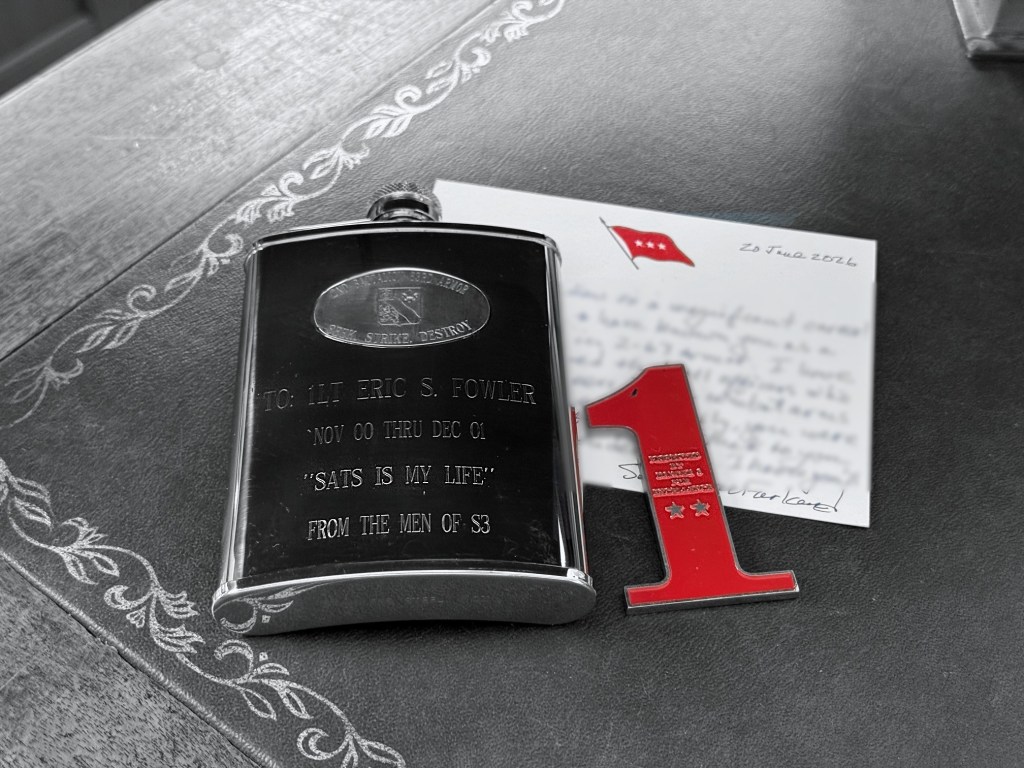
When my battalion’s turn came, our commander, LTC Sean B. MacFarland of 2-63 Armor, took a moment to explain to the general what the miles of paper were, and to introduce the person who had built the system that made them worth reading. General Craddock stood up from the head of the table, walked to the wall, and motioned for me to explain it. After a couple of fumbly moments, he pulled his hand from his pocket and thrust a coin into mine. It was one of the first challenge coins I ever earned, and it wasn’t just any one coin. It was The Big Red One.
LTC MacFarland went on to become Lieutenant General MacFarland, so he lost no momentum by sharing a bit of glory with a snot-nosed lieutenant. But he didn’t have to acknowledge me at all. I was, after all, just doing my job. He thought it was worth it, thought I was worth it, and I never forgot it. When I left the battalion, the men of the S3 shop gave me a flask engraved with four words: “SATS IS MY LIFE.” And when I retired this summer, twenty-five years later, he sent me a handwritten star note.
Credit drifts up the chain on its own. It only flows down when someone pushes it, and “great team effort” doesn’t cut it. A name, said out loud in the room that matters to that person’s future, does.
Gut check: whose hard work is pinned to your wall right now? When the boss walks over, will she ever hear their name?
Row Well and Live.
Talk this question over with your peers in ERETAI Connect. Request Your Invitation.
Next in the series: Earn Your No, arriving next Tuesday. The Gut Check series runs every Tuesday. See every question so far, or start at the beginning with Nobody Meets a Standard They Can’t See.
Get each new question by email, every Tuesday.

